
Once a year, your water utility is required by law to report exactly what is in your tap water, and most Fountain Valley homeowners never open it. That document, called a Consumer Confidence Report, is one of the most useful tools you have for understanding your water. It lists where your water comes from, what was detected over the past year, and whether anything crossed a safety limit. Here is how to find your Fountain Valley water quality report and read it without a chemistry degree.
- Public water systems must send customers a water quality report, or Consumer Confidence Report (CCR), every year.
- The report shows where your water comes from, what was detected, health information, and any violations.
- The EPA requires utilities to deliver the report by July 1 each year.
- A contaminant on the report simply means anything in the water besides water; it can be harmless or even beneficial, like chlorine.
- A violation means the utility missed a safe-drinking-water standard; check whether it caused a health risk and how it was fixed.
- Fountain Valley's water is drawn largely from the Orange County groundwater basin, so hardness and mineral content show up locally.
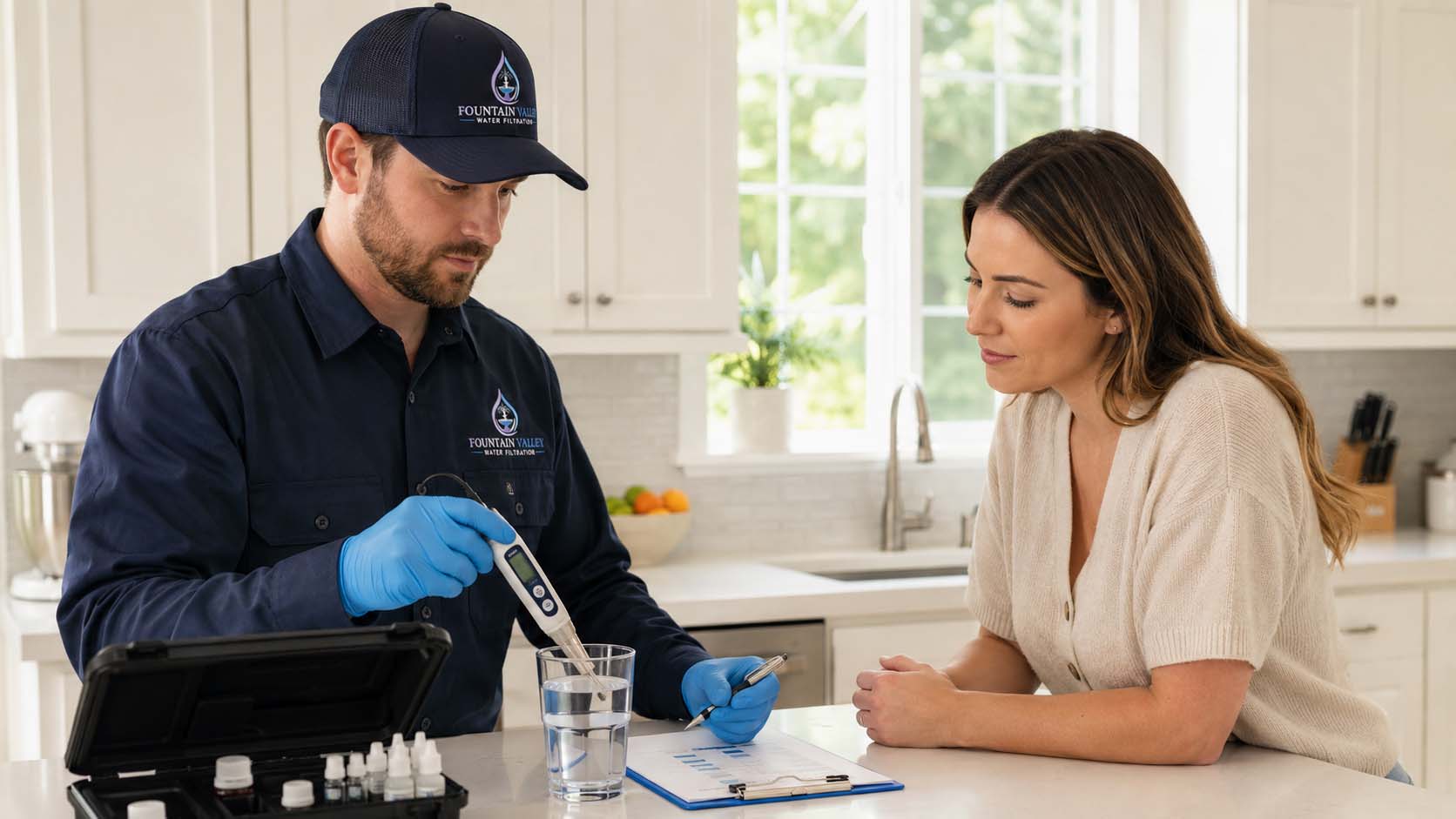
- If the report raises questions, an independent water test shows what is happening at your own tap.
Step 1: Find your Consumer Confidence Report.
Your water quality report is the annual Consumer Confidence Report your utility must provide. The CDC notes that anyone on a public water system is entitled to this report every year, and the EPA sets the delivery deadline at July 1. In Fountain Valley, look for it with your water bill, on your provider's website, or through the EPA's online CCR lookup. If you rent, your building manager or landlord may receive it on your behalf, so you may need to ask for a copy.
Not everyone gets one, though. The CDC explains that the yearly report goes to customers of community water systems that serve the same people all year. If your water comes from a private well, or from a place people do not stay long such as a gas station or campground, no report is issued and testing is up to you.
Step 2: Check where your water comes from.
Every report lists your source water, the rivers, reservoirs, or groundwater your tap water is drawn from. Most Fountain Valley water comes from the Orange County groundwater basin, which the Orange County Water District manages for 19 cities and about 2.5 million residents. The source explains a lot: groundwater picks up minerals as it moves through sand and gravel, which is why local water tends to be hard. The report may also note how your utility protects that source water and where to find source testing results.
Step 3: Read the water quality data table.
The heart of the report is a table of test results from the past year. Each row is a substance the utility tested for, with the level found and the limit allowed. The CDC suggests scanning for a column labeled violation, meets standard, or something similar to see whether any result exceeded a safe level. Common entries include disinfectants like chlorine, disinfection byproducts, and minerals; hardness is sometimes reported here too. A few terms show up on almost every report:
Step 4: Look for violations and health notes.
If your utility missed a standard, the report must describe the violation, what it was, how long it lasted, whether it posed a health risk, and how the utility is fixing it. The CDC recommends reading these sections closely and checking past reports to see whether a problem keeps recurring. The report also carries health information for people at higher risk from germs or chemicals in water, and it may point you to local resources, for example how to get your water tested for lead.
Step 5: Decide whether you need to treat your water.
A clean report means your water meets federal safety standards, but it does not mean the water is free of everything you might want to remove. Hardness, chlorine taste, and total dissolved solids are aesthetic issues a fully compliant report can still show. If the numbers, or a persistent taste, smell, or staining, bother you, an independent water test measures what is happening at your own tap. From there, options range from a carbon filter for chlorine taste to whole-house filtration for every faucet, and if the report confirms hard water, a softener or conditioner. Our guide comparing reverse osmosis and carbon filtration can help you match a system to what your report shows.
Step 6: Get your questions answered.
You do not have to interpret the report alone. The CDC recommends contacting your water utility, your local health department, or the EPA's Safe Drinking Water Hotline at 800-426-4791 if anything in the report is unclear. If you would rather see results for your specific home rather than the system-wide averages a report shows, a professional water test is the most direct way to find out what is coming out of your tap.
Reading your report once a year is a quick habit that pays off. It takes only a few minutes, it tells you whether your utility met every standard, and it gives you a baseline to compare against future years so you can spot any change in your Fountain Valley water early.