
If your drinking glasses come out of the dishwasher speckled with spots, your showerhead crusts over every few months, or soap never quite rinses off your hands, you are living with hard water in Fountain Valley. Nearly every home in the city draws from the same underground source, and that water arrives carrying a heavy load of dissolved minerals. Hard water will not make you sick, but it steadily wears on your plumbing, appliances, and water heater. This guide covers why the water here is hard, how to recognize it, and which treatment options actually make sense for an Orange County home.
- Hard water is water high in dissolved calcium and magnesium; it is an aesthetic nuisance, not a health hazard.
- Most Fountain Valley tap water comes from the Orange County groundwater basin, which naturally absorbs minerals from underground sand and gravel.
- The U.S. Geological Survey classifies water above 180 mg/L of calcium carbonate as very hard, and Southern California groundwater commonly lands in the hard to very hard range.
- The U.S. EPA treats hardness as a secondary, aesthetic issue rather than a health risk.
- Common signs include spotted glassware, soap scum, chalky scale on fixtures, and a water heater that works harder than it should.
- Treatment options run from a salt-based softener to a salt-free conditioner to whole-house filtration, each suited to a different household.
- A water test is the only way to learn your home's exact hardness and choose the right system.
What makes Fountain Valley's water hard?
Hard water is water with a high concentration of dissolved calcium and magnesium, and Fountain Valley's supply is naturally rich in both. According to the U.S. Geological Survey, water picks up hardness as it moves through soil and rock, dissolving minerals and carrying them into the groundwater supply. Much of the city's water is drawn from the Orange County groundwater basin, which the Orange County Water District — headquartered on Ward Street right here in Fountain Valley — manages for 19 cities and roughly 2.5 million residents.
That basin formed over thousands of years as the Santa Ana River laid down layers of sand and gravel. Water filtering slowly through those layers dissolves the calcium and magnesium that make it hard by the time it reaches your tap.
How hard is the water in Fountain Valley?
Exact hardness varies by source and season, but Orange County groundwater generally tests on the hard to very hard end of the scale. The U.S. Geological Survey classifies hardness by the amount of calcium carbonate dissolved in the water:
For the precise number at your address, check your water provider's annual Consumer Confidence Report or have your water tested on site. Because supplies are often blended and shift seasonally, the figure can move through the year, which is why a direct test beats a rule of thumb.
Is hard water in Fountain Valley bad for your health?
No — hard water is a nuisance, not a health hazard. The U.S. Environmental Protection Agency regulates the minerals behind hardness under its secondary drinking water standards, a set of non-enforceable guidelines aimed at aesthetic concerns like taste, staining, and scale rather than health. The USGS makes the same point, describing hardness as a property of water that is not a health concern but can be a genuine nuisance. In short, the calcium and magnesium in your water will not harm you; they simply leave their mark on everything the water touches.
What does hard water do to your home?
Hard water's real cost shows up on your fixtures, appliances, and water heater. When hard water is heated, dissolved minerals harden into scale — solid calcium carbonate deposits that build up inside pipes, boilers, and water heaters. The EPA notes this scale can restrict or even block water flow, and the USGS warns it shortens equipment life and lowers the efficiency of water heaters.
Day to day, the signs are smaller but constant: soap scum, spotted glassware, chalky buildup on showerheads and faucets, and detergents that never quite lather. None of it is dangerous, but the repairs and early replacements add up over the years. Protecting a water heater from hard-water scale is one of the most common reasons homeowners here decide to treat their water.
How can you tell if you have hard water?
The clearest signs of hard water are things you can see and feel: cloudy spots on clean glassware, a filmy residue after washing your hands, chalky scale ringing faucets and showerheads, and skin or hair that feels dry after a shower. A water heater that runs longer or noisier than it used to is another clue, since scale insulates the heating element and forces it to work harder. The only way to be certain — and to size the right system — is a water test that measures hardness directly.
What are your options for treating hard water in Fountain Valley?
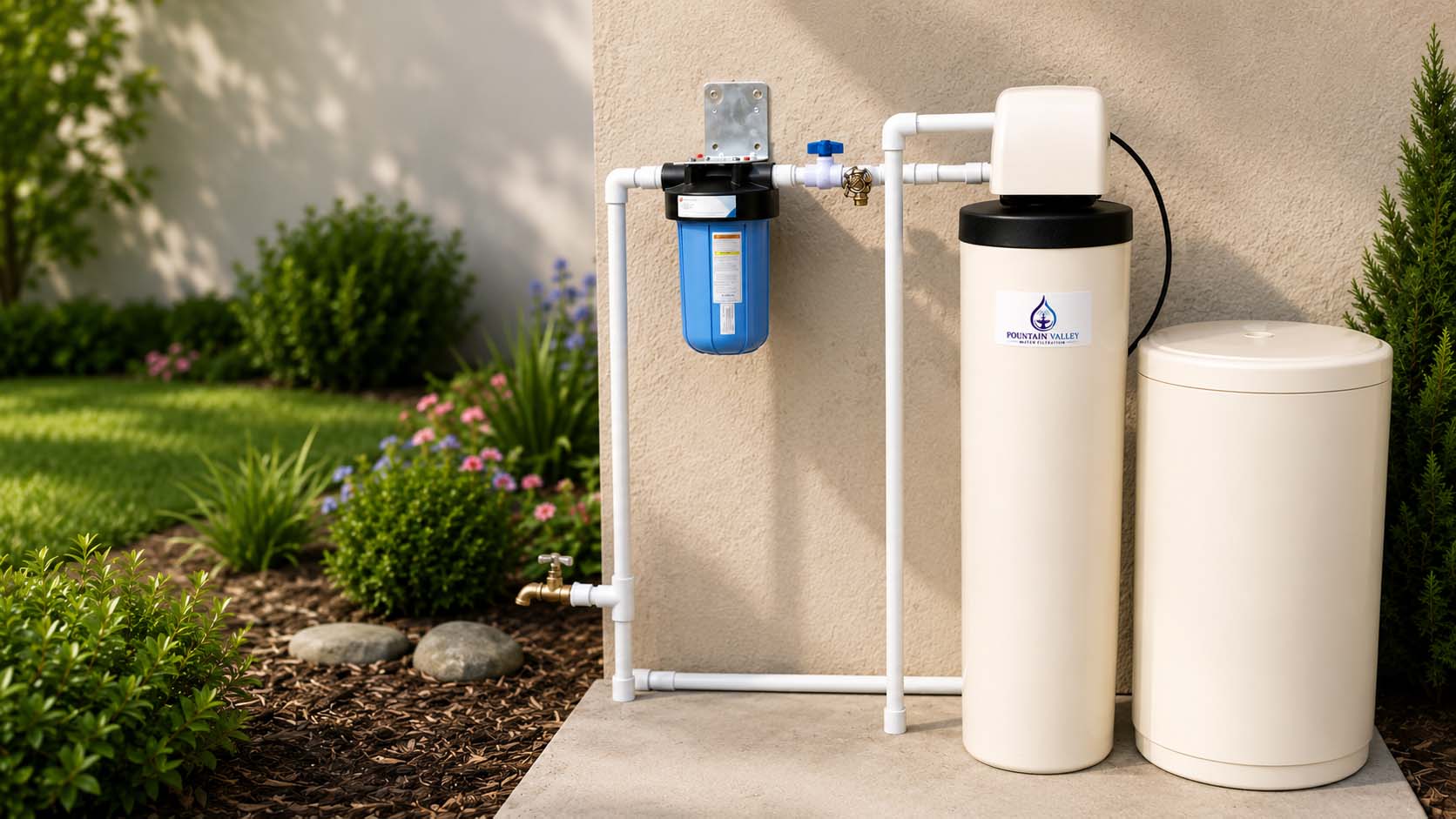
Three approaches handle hard water, and the right one depends on your goals. A salt-based water softener uses ion exchange to remove calcium and magnesium entirely, delivering classic soft water — the strongest choice if you want to stop spotting and protect appliances. A salt-free conditioner leaves the minerals in place but changes their form so they are far less likely to stick, a lower-maintenance path for households that want scale control without salt or a drain line.
Whole-house filtration tackles more than hardness, cutting chlorine, sediment, and taste issues at every tap. Many Fountain Valley homes pair a softener or conditioner with whole-house filtration; a water test and a look at your plumbing point to the right combination for your household.
Fountain Valley Hard Water: Common Questions
Yes. Hardness is an aesthetic issue rather than a health one, and local tap water is treated to meet state and federal drinking-water standards. If you want to reduce chlorine taste or dissolved minerals at the kitchen tap, a dedicated drinking-water filter or reverse osmosis system can help.
Usually, yes. Spotting comes from the calcium and magnesium in hard water, and a salt-based softener removes those minerals through ion exchange, which typically clears up glassware spots and soap scum.
Check your water provider's annual Consumer Confidence Report for a published hardness figure, or schedule an on-site water test. A test measures your home's water directly, which matters because local supplies can be blended and change from season to season.