
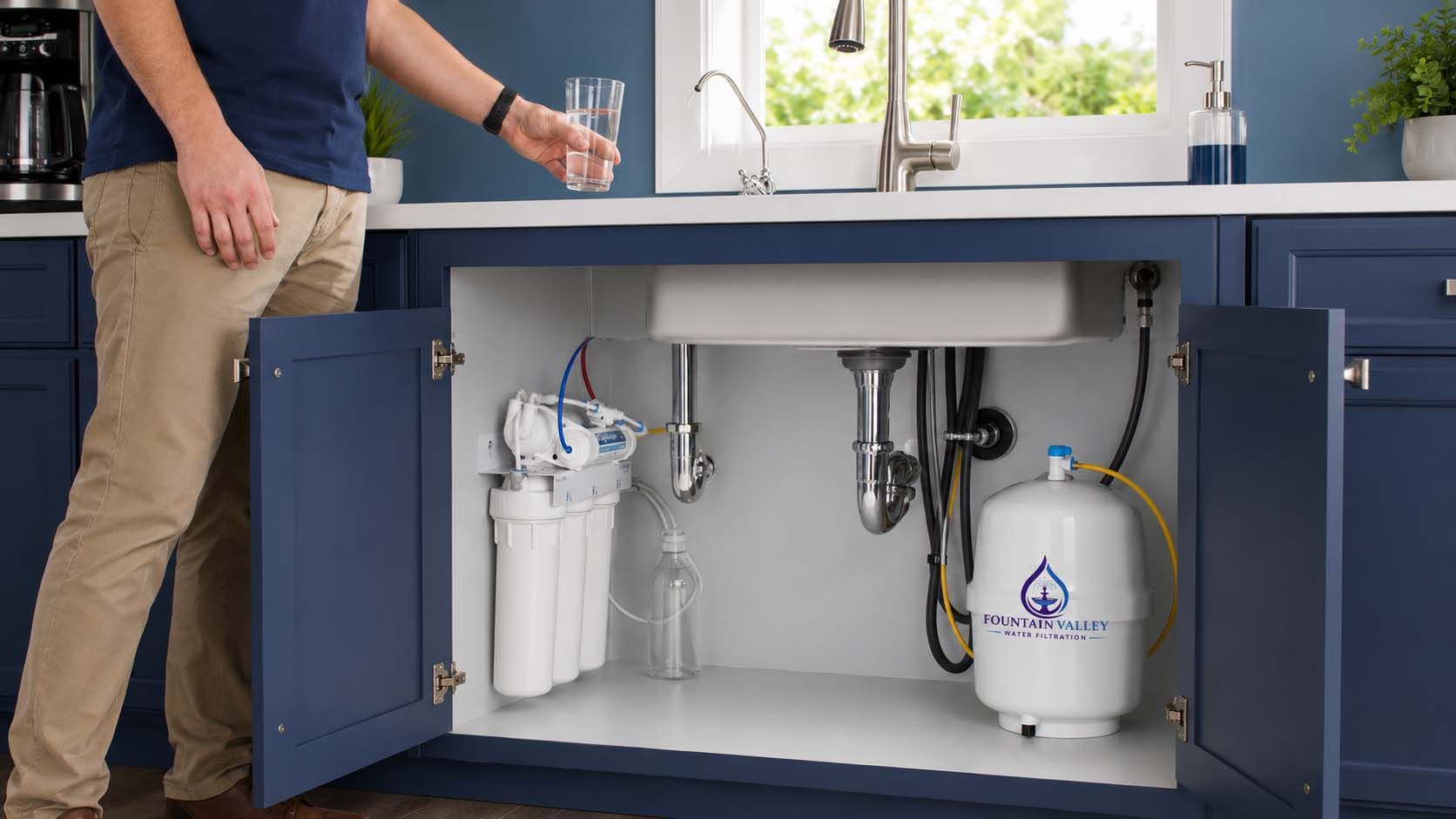
One of the most common questions we hear from Fountain Valley homeowners is simple: should you get a reverse osmosis system or a carbon filter? Both improve your drinking water, but they work in completely different ways and solve different problems. Reverse osmosis and carbon filtration are less rivals than tools for separate jobs. Here is how each one works, what it removes, and how to tell which one your home actually needs.
Carbon filtration improves the taste and smell of your water.
Carbon filtration uses activated carbon to absorb the substances that make water taste and smell off. According to the CDC, pitcher and refrigerator filters usually rely on activated carbon, and their main purpose is to improve taste and smell rather than safety. The EPA adds that granular activated carbon removes most of the contaminants that cause odors, color, and foaming. In a Fountain Valley kitchen, a carbon filter is what takes the chlorine taste and smell out of your tap water, and many carbon products are certified to NSF Standard 42, the benchmark for taste and odor reduction.
Carbon does more than freshen flavor. The CDC notes that these filters can also reduce heavy metals like lead, and better cartridges cut a range of organic compounds. What carbon does not do is remove dissolved minerals like calcium and magnesium or most dissolved solids, so it will not soften hard water or lower your total dissolved solids reading. It is inexpensive, low-maintenance, and leaves beneficial minerals in the water, which is why it is the most common first filter in a home.
Reverse osmosis removes dissolved minerals and chemicals.
Reverse osmosis pushes water through a semipermeable membrane that blocks particles far smaller than carbon can catch. The CDC states that reverse osmosis filters remove some chemicals, including lead, copper, chromium, chloride, and sodium, and may also reduce arsenic, fluoride, sulfate, calcium, magnesium, and nitrate. Because the membrane pores are so small, the CDC also lists reverse osmosis among the systems that remove germs, including parasites, bacteria, and viruses. The EPA groups reverse osmosis with the treatments effective at removing total dissolved solids and other inorganic substances.
Most RO systems include a carbon stage too, so they improve taste while stripping out dissolved solids. For drinking-water RO units, look for certification to NSF Standard 58, the standard written specifically for reverse osmosis, just as Standard 42 covers carbon filters. That thoroughness has trade-offs: RO systems cost more, need periodic membrane changes, send some water down the drain during filtering, and usually serve a single tap, most often as an under-sink unit at the kitchen sink.
How the two compare at a glance.
The quickest way to see the difference is side by side:
What neither filter does on its own.
Neither a carbon filter nor a reverse osmosis unit softens your water the way a dedicated system does. Fountain Valley draws heavily on the hard groundwater of the Orange County basin, and a carbon filter leaves those hardness minerals untouched while an under-sink RO unit only treats one tap. If scale on your fixtures and spotting on your glassware are the main problem, the fix is a softener or conditioner, which we cover in our guide to hard water in Fountain Valley. It is also worth knowing that a whole-house carbon filter that removes chlorine can let more germs grow downstream in your plumbing, per the CDC, which is one reason point-of-use filtration is often the simpler choice.
Every filter needs upkeep, too. The CDC stresses that filters only work when the cartridges or membranes are replaced on the manufacturer's schedule, and that a neglected filter can become a place for germs to grow. Carbon cartridges are cheap and quick to swap; RO membranes last longer but cost more to replace, so factor ongoing maintenance into the decision, not just the purchase price.
When to choose which system.
Choose based on the problem you want to solve, not on which technology sounds stronger. If your main complaint is the chlorine taste and smell of Fountain Valley tap water, a carbon filter, at the kitchen tap or for the whole house, is usually the simpler, more economical fix. If you want the lowest possible level of dissolved solids for drinking and cooking, or you are concerned about specific contaminants like lead, sodium, or nitrate, reverse osmosis is the more complete answer.
Plenty of homes use both, and they pair naturally: a whole-house carbon filter handles chlorine everywhere while an under-sink RO unit polishes the water at the kitchen tap. Because Fountain Valley's water is also hard, some households add a softener or conditioner alongside either one. A water test shows exactly what is in your water, which makes the decision straightforward.
Reverse Osmosis and Carbon Filters: Common Questions
Generally no. Standard carbon filters are built for taste, odor, and certain organic compounds, and they are not designed to remove fluoride. If reducing fluoride is your goal, reverse osmosis is the system that can lower it, according to the CDC.
Often, yes. An under-sink RO unit improves the water at one tap, but it does nothing for the hardness reaching your water heater, showers, and appliances. To protect the whole house from scale, a softener or conditioner does the job a single-tap filter cannot.