
Orange streaks in the toilet bowl, a rusty ring around the bathtub drain, laundry that comes out stained instead of clean, or a whiff of rotten eggs when you turn on the tap: these are some of the most common water complaints we hear from homeowners around Fountain Valley. They are not usually dangerous, but they are stubborn, and ordinary cleaning never really fixes them because the source is in the water itself. Two culprits are behind most of it, iron and sulfur, sometimes joined by a third, manganese. Here is how to tell which one you are dealing with, why it shows up in local water, and how it gets removed for good.
- Rusty, orange, or reddish staining on fixtures and laundry usually points to iron in the water.
- A rotten-egg smell usually points to hydrogen sulfide, a form of sulfur.
- Black or brown specks and staining usually point to manganese, which often travels with iron.
- The U.S. EPA classifies iron, manganese, sulfate, and odor as secondary, aesthetic issues rather than health hazards.
- These minerals dissolve into water as it moves through underground rock and soil, so they are common in groundwater and well supplies.
- Cleaning alone will not solve the problem because the minerals keep arriving with the water.
- A water test identifies which minerals are present and at what level, which determines the right treatment system.
Rusty, orange staining usually means iron in your water.
Iron is the most common reason for orange and reddish-brown stains on sinks, tubs, toilets, and laundry. The U.S. EPA lists iron among its secondary drinking water standards at 0.3 milligrams per liter, and above that level the noticeable effects are a rusty color, sediment, a metallic taste, and reddish or orange staining. The EPA's guidance for well owners makes the same connection directly: stained plumbing fixtures and laundry point to iron, copper, or manganese. Iron itself is not considered a health threat at these levels, but it is relentless on your fixtures and appliances, and it can give drinking water a distinct metallic taste. It also builds up inside pipes and water-using appliances over time, which is why many homeowners treat it rather than live with it.
A rotten-egg smell usually means hydrogen sulfide.
That unmistakable rotten-egg odor is almost always hydrogen sulfide gas dissolved in the water. The U.S. EPA lists odor among its secondary standards at a threshold odor number of 3, describing the effect as a rotten-egg, musty, or chemical smell, and its guidance for well owners specifically ties an objectionable taste or smell to hydrogen sulfide, corrosion, or metals. Hydrogen sulfide is a nuisance rather than a health hazard at the low levels typically found in home water, but it is deeply unpleasant, it can tarnish silverware and fixtures, and it sometimes gets stronger in hot water, which is why the smell often seems worse in the shower. Because the gas comes and goes, it is worth confirming with a test rather than guessing.
Black specks and staining usually point to manganese.
Manganese is iron's frequent companion, and it leaves darker marks. The U.S. EPA sets a secondary standard for manganese at 0.05 milligrams per liter, and above that level it causes a black to brown color, black staining, and a bitter, metallic taste. If you see dark specks in your water, black staining in the dishwasher or on laundry, or a grimy dark film in the toilet tank, manganese is a likely cause. Like iron, it is an aesthetic problem rather than a health one at typical levels, and the two are often removed together by the same treatment system because they behave similarly in water.
These problems start with your water source.
Iron, sulfur, and manganese are natural, and they come from the ground. The U.S. Geological Survey explains that as water moves through soil and rock, it dissolves small amounts of naturally occurring minerals and carries them into the groundwater supply. Fountain Valley and the surrounding Orange County area sit above a groundwater basin, and homes on private wells in the region draw water that has been in direct contact with the minerals in the local geology. That is why iron and sulfur problems tend to be most pronounced on well water, though they can appear anywhere the source water is mineral-rich. The pattern of symptoms is a useful first clue:
The table is a starting point, not a diagnosis, because more than one mineral is often present at once.
Iron and sulfur are nuisances, not usually health hazards.
It is worth saying clearly: at the levels that cause staining and odor in a typical home, iron, manganese, sulfate, and hydrogen sulfide are aesthetic problems, not health emergencies. The EPA groups them under secondary drinking water standards, a set of non-enforceable guidelines aimed at taste, color, odor, and staining rather than health risk. That does not mean you should ignore them. Left untreated, iron and manganese stain everything the water touches and build up in pipes, water heaters, and appliances, shortening their life and lowering their efficiency, and the rotten-egg smell makes water unpleasant to drink and cook with. The reason to treat them is quality of life and protecting your plumbing, not fear.
How iron and sulfur are removed.
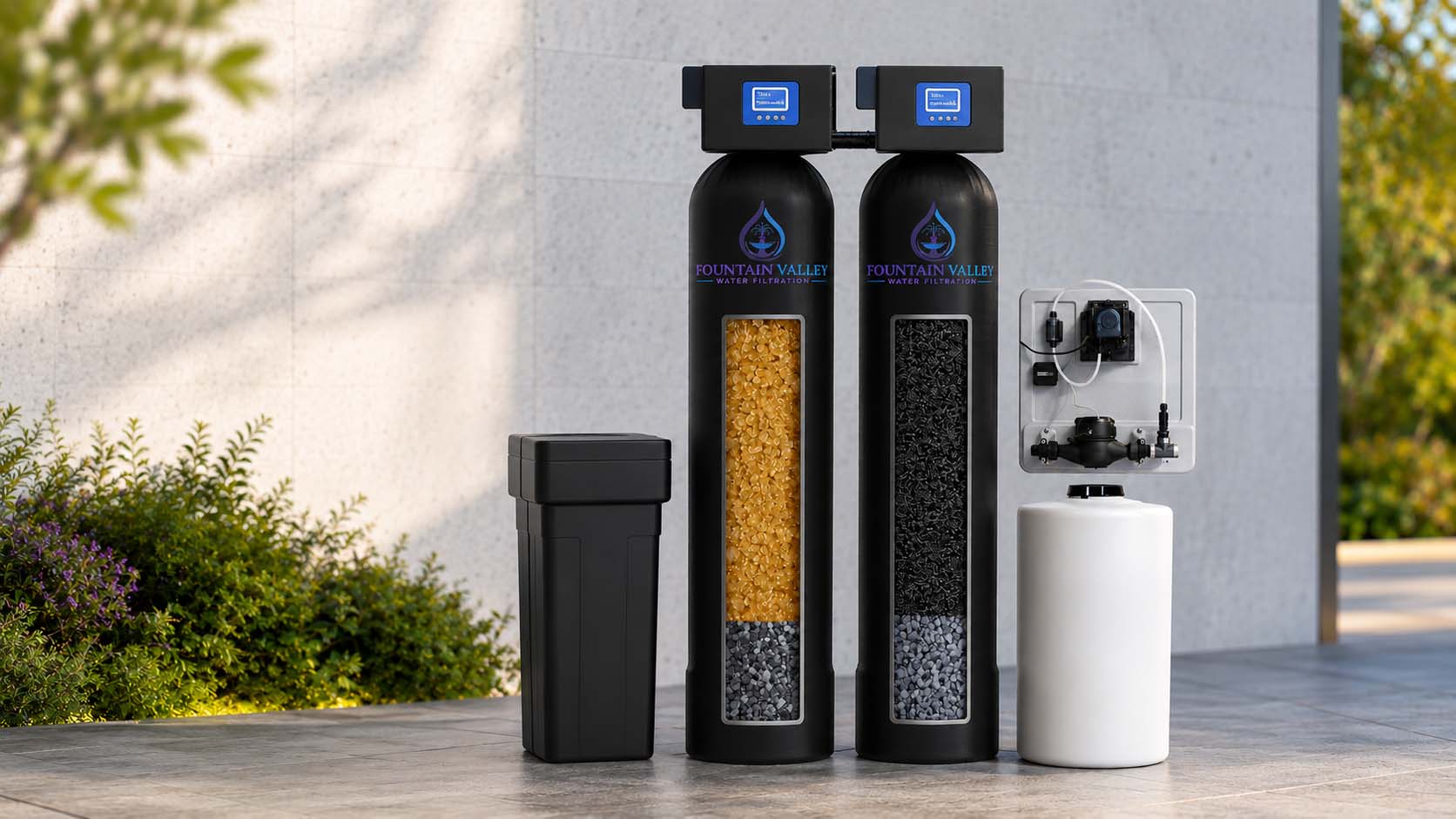
Because these minerals are dissolved in the water, a surface cleaner cannot touch the cause; the fix is a treatment system that removes them before the water reaches your taps. In practice, iron, manganese, and hydrogen sulfide are handled by whole-house systems designed to convert the dissolved minerals and gas into a form that can be filtered out, so every faucet, shower, and appliance gets treated water. The right system depends on which minerals are present, how much of each, and the chemistry of your particular water, which is exactly why a water test comes first. The EPA notes that filtration is one of the on-site treatment processes that can remove contaminants found in well water, and it stresses using test results to guide the choice. For a Fountain Valley home, the practical path is straightforward: test the water to identify iron, sulfur, and manganese levels, then match a system to the results. A professional assessment of iron and sulfur removal, paired with a look at your plumbing, turns a frustrating stain-and-smell problem into a solved one. If your water also leaves scale and spots, a softener or conditioner may be part of the same solution, since hard water frequently accompanies mineral-rich groundwater.
Testing tells you what you are actually dealing with.
Because the symptoms overlap, a test is the only way to know exactly which minerals are in your water and how much of each. Iron and manganese often appear together, hydrogen sulfide comes and goes, and hard-water minerals frequently ride along with all of them, so eyeballing the stains only gets you so far. The EPA advises well owners to base treatment on test results rather than assumptions, and for private wells it recommends testing at least once a year for the basics along with anything your local conditions suggest. A professional water test measures iron, manganese, sulfur, hardness, and related indicators at once, and the numbers determine both the type of system and its size. Guessing tends to lead to a system that is either underpowered for the problem or larger than you need, so the small step of testing first usually saves money.
It also matters because a stain or smell is not always the water. Blue-green staining, for instance, usually points to copper or corroding pipes rather than a mineral in the source water, and a metallic taste can come from either the water or the plumbing. Sorting out source-water minerals from plumbing issues is part of what a test and a walkthrough of your system accomplish.
Fountain Valley Iron and Sulfur Questions
At the levels that cause staining and the rotten-egg smell in a typical home, the EPA treats iron, manganese, sulfate, and odor as aesthetic issues rather than health hazards. They make water unpleasant and stain your fixtures, but they are not the same category as a regulated health contaminant. A test confirms the levels so you know where you stand.
Hydrogen sulfide often becomes more noticeable in hot water because heat drives the dissolved gas out of solution, releasing more of the odor as you run the tap or shower. If the smell is strongest from the hot side only, the water heater can be involved, which is something a professional can check as part of diagnosing the problem.
Sometimes a softener reduces low levels of iron, but heavier iron, manganese, and hydrogen sulfide usually need a dedicated removal system built for those minerals. Because hard water so often accompanies them here, the right answer is frequently a combination, which is another reason to start with a test and a full look at your water.