
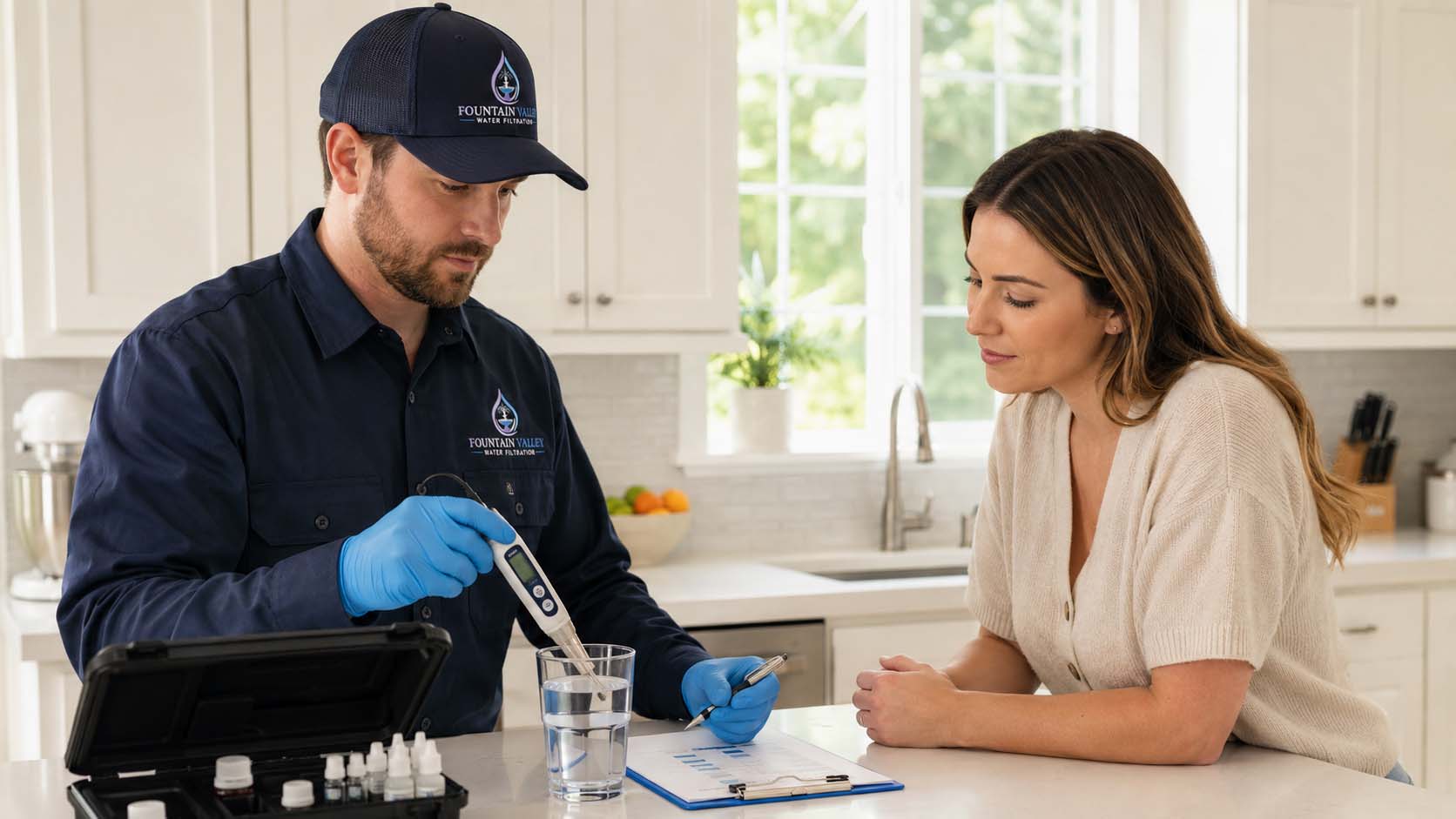
How much does water filtration cost in Fountain Valley? The honest answer is that it depends on what your water needs fixed and how much of the house you want treated, but the ranges are more predictable than most quotes make them sound. Fountain Valley sits on top of the Orange County groundwater basin, and that local water sets the starting point for almost every system. This guide breaks down real market ranges for whole-house filtration, reverse osmosis, and water softeners, and the factors that push your number toward the low or high end.
- Whole-house carbon filtration typically runs about $1,000 to $4,000 installed, depending on home size and media.
- A water softener usually lands between roughly $1,000 and $3,500 installed, with hardness and household size driving the capacity you need.
- An under-sink reverse osmosis system for drinking water commonly costs about $300 to $1,200 installed.
- Salt-free conditioners and UV disinfection generally fall in the $500 to $2,500 range.
- Fountain Valley's hard groundwater makes softening or scale prevention the most common cost driver.
- Ongoing upkeep such as salt, cartridges, and membranes adds a modest yearly cost most quotes leave out.
The Short Answer on Water Filtration Costs
Most Fountain Valley homes spend somewhere between about $300 for a single drinking-water filter and $6,000 or more for a whole-house system paired with a softener, based on national pricing guides. Where you land comes down to three things: the size of your home, what a water test actually finds, and how much of the house you decide to treat. A point-of-use filter under one sink is the cheapest way in; treating every tap costs more but solves more problems at once. The table below shows typical installed market ranges by system type so you can see roughly where each option sits before anyone visits your home.
| System | Typical installed range | Best for |
|---|---|---|
| Under-sink reverse osmosis | $300–$1,200 | Crisp drinking water at one tap |
| Whole-house carbon filtration | $1,000–$4,000 | Chlorine, taste, and odor at every tap |
| Water softener | $1,000–$3,500 | Hard-water scale and spotting |
| Salt-free conditioner | $500–$2,500 | Scale control without salt |
| UV purification | $500–$1,500 | Disinfecting well or vulnerable supplies |
| Whole-house filter plus softener | $2,500–$6,000+ | Complete treatment for hard, chlorinated water |
These ranges reflect national market pricing rather than any single quote, and an on-site test is what sets the real number for your address.
Why Hard Water Is the Biggest Cost Driver Here
Hard water is the single factor that most often decides what a Fountain Valley homeowner spends. The city draws most of its supply from the Orange County groundwater basin, which the Orange County Water District, headquartered right here in Fountain Valley, manages as roughly 85 percent of the supply for about 2.5 million people across north and central Orange County. That groundwater tends to test on the hard to very hard end of the scale, and the exact hardness varies by source and season. The Water Quality Association defines soft water as less than one grain of hardness per gallon, and local water sits well above that line, which is why softeners and scale-prevention systems come up so often in this area. Hardness matters to your budget because it sets the softener capacity you need. A larger household pulling harder water calls for a higher-grain system, and that unit costs more than an entry-level softener sized for a small home. Dissolved calcium and magnesium also build scale inside pipes and water heaters, and that scale quietly raises energy bills and shortens appliance life. That is why many homeowners treat a water softener or scale prevention as protection for the house rather than a luxury, and it is often the line item that moves a quote the most.
What Drives the Price of a Whole-House System
A whole-house, or point-of-entry, system is priced mainly by how much water it has to handle and how easy it is to install. A larger home with more bathrooms needs a system rated for higher flow, so a four-bathroom house will generally cost more to outfit than a two-bathroom one. Where your main water line enters the property matters too: a clean, accessible spot in the garage is a straightforward install, while a tight or buried connection adds labor. Media choice changes the price as well, since a standard carbon tank costs less than a catalytic media chosen to tackle chloramine. Permits, any needed plumbing rework, and whether you are on city water or a private well all shift the total. Because those variables stack, two Fountain Valley homes on the same street can land at different numbers for what looks like the same whole-house water filtration setup.
Reverse Osmosis and Drinking-Water Costs
Reverse osmosis is usually the most affordable way to upgrade drinking water specifically, with an under-sink system commonly installed for about $300 to $1,200. Homeowners often choose it even when their tap water is considered safe, because taste is an aesthetic issue rather than a health one. The U.S. EPA sets a secondary standard for total dissolved solids at 500 milligrams per liter as a taste-and-appearance guideline, not a health limit, and reverse osmosis is one of the few systems that meaningfully lowers TDS. When you shop, the CDC recommends looking for an NSF certification on the label, with NSF/ANSI Standard 58 covering reverse osmosis performance. The trade-offs are ongoing: an RO system sends some water to the drain to make each gallon, and it relies on replacement filters plus a membrane, so the sticker price is only part of the cost of owning an under-sink drinking water filter over time.
The Ongoing Costs Most Quotes Skip
The cheapest system to install is not always the cheapest to own, and upkeep is where that gap shows up. A water softener needs salt, which typically runs about $50 to $150 a year depending on how hard your water is and how much you use. Reverse osmosis filters are usually swapped once or twice a year for roughly $50 to $150, with the membrane replaced every two to three years. Whole-house carbon media is generally replaced every few years, often in the $200 to $600 range, and softener resin can last a decade or more before it needs attention. None of these numbers are large on their own, but they are real, and a quote that ignores them makes a system look cheaper than it is. When you compare two options, it is worth asking what each one costs to keep running, not just what it costs to put in.
How to Get an Accurate Number for Your Home
The only way to price your system precisely is to start with what is actually in your water. The CDC notes that taste, smell, and appearance are not reliable indicators of what a supply contains, so guessing from the tap can send you toward the wrong system. Your annual Consumer Confidence Report from the water provider gives a citywide snapshot, but hardness and mineral content can vary by address and season, which is why an on-site test is the honest starting point. From there, ask for an itemized, flat-rate quote that separates equipment, installation, and expected upkeep so you can compare options on the same terms. A test-first approach keeps you from paying for treatment you do not need, and it makes sure the money you do spend targets the real problem, starting with water testing and analysis before any system goes in.
What Actually Moves Your Number in Fountain Valley
The biggest levers on your final price are how hard your water tests, how much of the house you choose to treat, and how much upkeep you are willing to budget, far more than the brand name on the tank. Because Fountain Valley's groundwater runs hard, softening or scale prevention is usually what pushes a quote up, while a single drinking-water filter keeps it low. The smartest move is to price the real problem: test first, then match the system to what the water shows. If you are weighing options for your own home, the team at Fountain Valley Water Filtration can test your water and put honest numbers next to whole-house filtration, a water softener, or a drinking-water system so you can compare them side by side.