
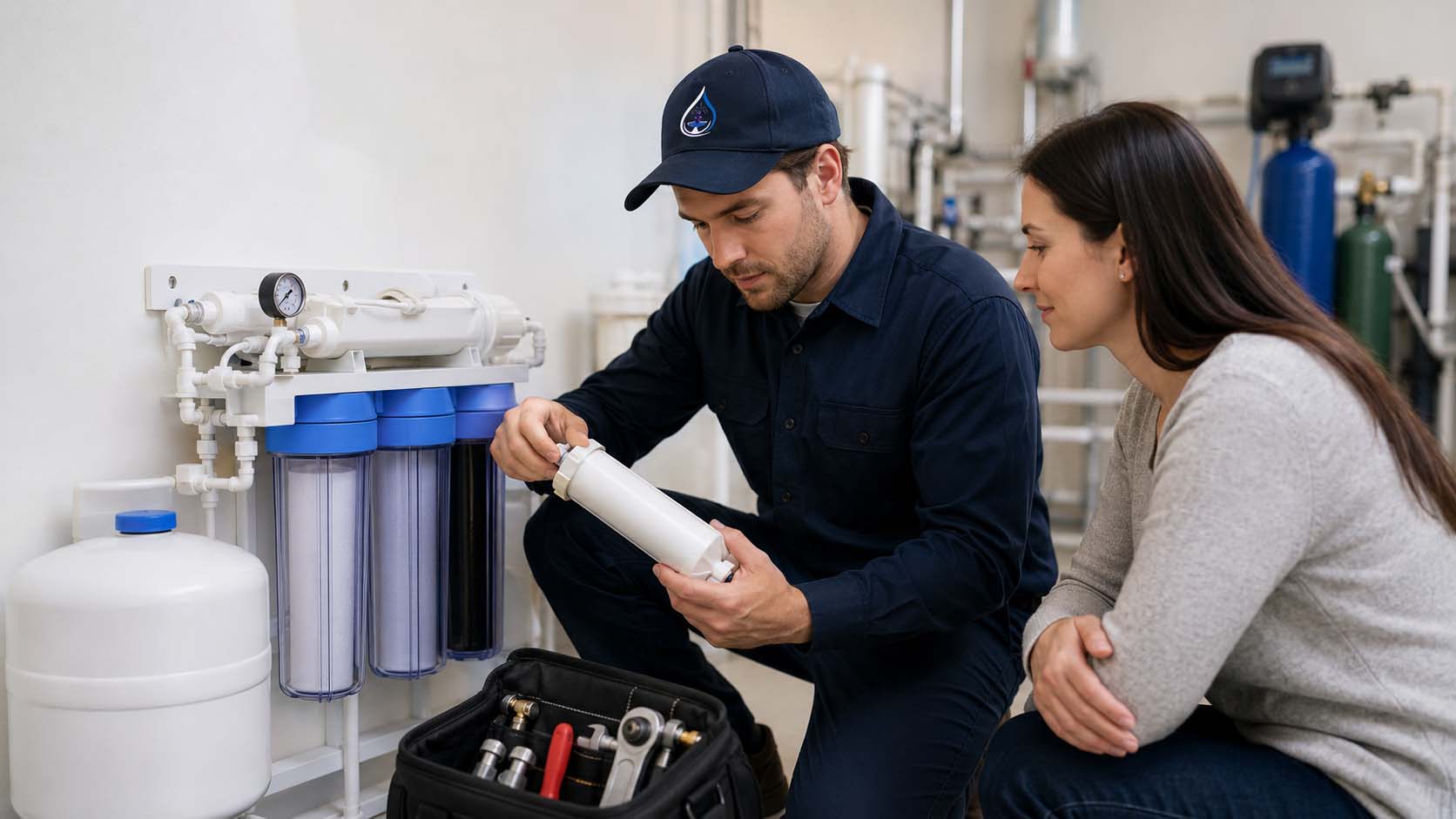
A water filter only protects your home while it still has capacity to spare. Push it past that point and it quietly stops doing its job, sometimes while the water still looks and tastes fine. Knowing how often to replace a water filter, and when a water softener needs service, is what keeps a system you paid good money for actually working. This guide from Fountain Valley Water Filtration lays out a practical replacement schedule by system type for local homes, where hard Orange County groundwater tends to shorten the interval between changes.
How Often Should You Replace a Water Filter?
Most point-of-use cartridges last three to twelve months, and whole-house media runs a similar range, but the honest answer is that the number printed on the box matters more than any rule of thumb. Every certified filter is rated for a service cycle, which NSF explains may be a specific number of gallons or an estimate of the number of months that a cartridge will last. Two Fountain Valley homes with the same filter can hit that limit months apart depending on how much water they use and how hard it is. The table below gives typical intervals and the warning signs that a change is overdue; treat them as a starting point, then let your own water and the manufacturer's rating fine-tune the dates.
| System or component | Typical replacement interval | Signs it is due |
|---|---|---|
| Sediment pre-filter | Every 2 to 6 months | Dropping water pressure, visible grit in the housing |
| Carbon filter (whole-house or under-sink) | Every 6 to 12 months | Chlorine taste or smell returning, flat-tasting water |
| Reverse osmosis pre- and post-filters | Every 6 to 12 months | Slower tank fill, a change in taste |
| Reverse osmosis membrane | Every 2 to 5 years | Rising TDS reading, less water at the tap |
| UV disinfection lamp | About every 12 months | Replace yearly even if the lamp still glows |
| Water softener salt | Check monthly, refill as needed | Brine tank low, hardness symptoms returning |
| Water softener resin | Typically 10 to 15 years | Softener running but scale and spotting creep back |
When Do Whole-House Sediment and Carbon Filters Need Changing?
A whole-house system usually runs a sediment pre-filter that needs changing every two to six months and a carbon stage every six to twelve. The pre-filter catches sand, silt, and rust before they reach the carbon, so it clogs first, and a clogged cartridge is easy to spot. As mechanical filtration fills, the flow rate slows noticeably and the pressure at your fixtures drops. If your shower weakens a few weeks after a change, your water is dirtier than average and you have just found your real interval. Fountain Valley's sandy coastal-plain groundwater can load a sediment filter faster than a spec sheet assumes, which is one reason a whole-house water filtration system here often needs more frequent pre-filter swaps than the same unit would in a city with cleaner source water. When a cartridge change no longer restores pressure or taste, that is usually a service call rather than a simple swap, and our water filter repair and maintenance page covers what that involves.
How Often Should You Replace Reverse Osmosis and Under-Sink Filters?
An under-sink drinking filter or reverse osmosis system needs its cartridges changed every six to twelve months, and the RO membrane itself every two to five years. The sequence matters. In an RO system the inexpensive carbon and sediment pre-filters exist to protect the membrane, which is the costly part. Let the pre-filters clog and chlorine or grit reaches the membrane and shortens its life, so skipping the cheap changes only buys you an expensive one. You will know the membrane is tiring when the storage tank takes longer to fill or a TDS meter reads higher than it used to. A simple under-sink drinking water filter is lower maintenance, usually one or two cartridges a year, while a multi-stage reverse osmosis system trades a little more upkeep for the lowest mineral content at the tap. Either way, buy the exact replacement cartridge the maker specifies, because an off-spec filter can fit the housing and still underperform.
What Maintenance Does a Water Softener Need, and How Often?
A water softener needs three things on a schedule: salt kept topped up, the occasional deep clean, and resin replaced near the end of its life. Check the brine tank monthly and add salt before it drops below a third full; in a hard-water area like ours the softener regenerates often, so it goes through salt faster than many homeowners expect. Once or twice a year, inspect the tank for a salt bridge, a hard crust that leaves the system regenerating without actually drawing salt, and break it up. The resin bed that does the softening typically lasts ten to fifteen years, and when a working softener stops keeping scale and spotting at bay, tired resin is often the reason. Salt-free conditioners change this math: a salt-free water conditioner has no brine tank to refill, though it conditions scale rather than removing hardness. If you would rather not manage any of it, a water softener installation done right includes sizing the unit to your household so it is not regenerating more than it needs to.
Does Fountain Valley's Water Change How Often You Replace Filters?
Yes, local water chemistry pushes most Fountain Valley homes toward the shorter end of every interval above. The city sits over one of the region's major groundwater supplies. The Orange County Water District, headquartered right here in Fountain Valley at 18700 Ward Street, manages the basin that provides about 85 percent of the water supply for 2.5 million people across north and central Orange County, recharged largely with Santa Ana River water. That groundwater runs hard, and hard water is tough on equipment, because the dissolved minerals that leave scale on your fixtures also load softener resin and coat filter media faster. More scale and sediment in the water means filters reach their rated capacity sooner, softeners regenerate more often, and the every-twelve-months on the box is often really every eight or nine here. The only way to set your true schedule is to measure what is coming out of your pipes, and an on-site water test for hardness, chlorine, and TDS turns a generic interval into one built around your home.
What Happens If You Skip Filter Changes?
A filter left in past its service life stops protecting you and can make your water worse than no filter at all. The CDC advises changing filters according to the manufacturer's recommendations to keep a system working properly and prevent germs from growing in it; an exhausted cartridge is a damp bed of trapped organic matter, not a barrier. Performance fails quietly: carbon that is full can no longer hold chlorine or improve taste, and a clogged sediment filter chokes flow to the whole house. There is a downstream cost, too. A neglected RO pre-filter shortens the membrane's life, and a softener that is out of salt lets hard water scale your water heater and fixtures, which is the exact problem scale prevention and water heater protection is meant to prevent. Replacing a cartridge on time is the cheapest maintenance in the house; skipping it just moves the expense to the equipment downstream.
Water Filter Maintenance FAQ for Fountain Valley Homes
How do I know when my water filter needs changing?
Watch for three tells: a drop in water pressure or flow, the return of chlorine taste or odor, and the date the manufacturer printed on the filter. Any one of them means it is time. In harder water you will usually hit the pressure or taste cue before the date.
Can I rinse and reuse a water filter cartridge?
No, rinsing a spent carbon or sediment cartridge does not restore it. Carbon works by adsorption, and once its surface is full it cannot hold more contaminants no matter how you clean it. Pleated sediment filters can sometimes be rinsed once or twice, but they are inexpensive and replacing them is the reliable fix.
How often should I replace a refrigerator or pitcher water filter?
Most refrigerator and pitcher filters are rated for about six months or a set number of gallons, whichever comes first. A household that drinks a lot of filtered water will reach the gallon limit before the calendar date, so follow whichever you hit sooner.
Does a water softener have a filter that needs replacing?
Not in the cartridge sense; a softener's working part is a resin bed, not a disposable filter. You maintain it by keeping the brine tank full of salt and cleaning it periodically, and the resin itself is replaced only every ten to fifteen years or so. Some homes add a sediment or carbon filter alongside the softener, and those do follow the schedules above.
Is Fountain Valley's water hard enough to need a softener?
Orange County's groundwater is on the hard side, and most local homes see the scale, spotting, and shortened appliance life that come with it. Whether you need a softener, a salt-free conditioner, or targeted filtration depends on your own numbers, and a water test is the honest place to start.